Why GCSE Maths Matters – and How to Improve Without a Tutor
GCSE Maths matters because it does much more than provide one exam grade. A secure result can affect sixth-form subject choices, support later university applications and provide mathematical skills used across science, economics, technology and everyday life. The good news is that many students can make substantial progress independently using high-quality free resources and a structured revision plan.
GCSE Maths is sometimes treated as a hurdle: get a pass, put the calculator away and move on. That view underestimates both the breadth of the subject and the role mathematics can play in future study.
Students use GCSE Maths to develop confidence with number, algebra, graphs, percentages, probability, statistics, geometry and problem-solving. Those skills do not disappear after Year 11. They form part of the foundation for A-level subjects, university courses, employment and many everyday financial decisions.
That does not mean every student must achieve a grade 9 or study A-level Maths. A more useful goal is to become as mathematically capable as possible and achieve a grade that keeps appropriate future options open.
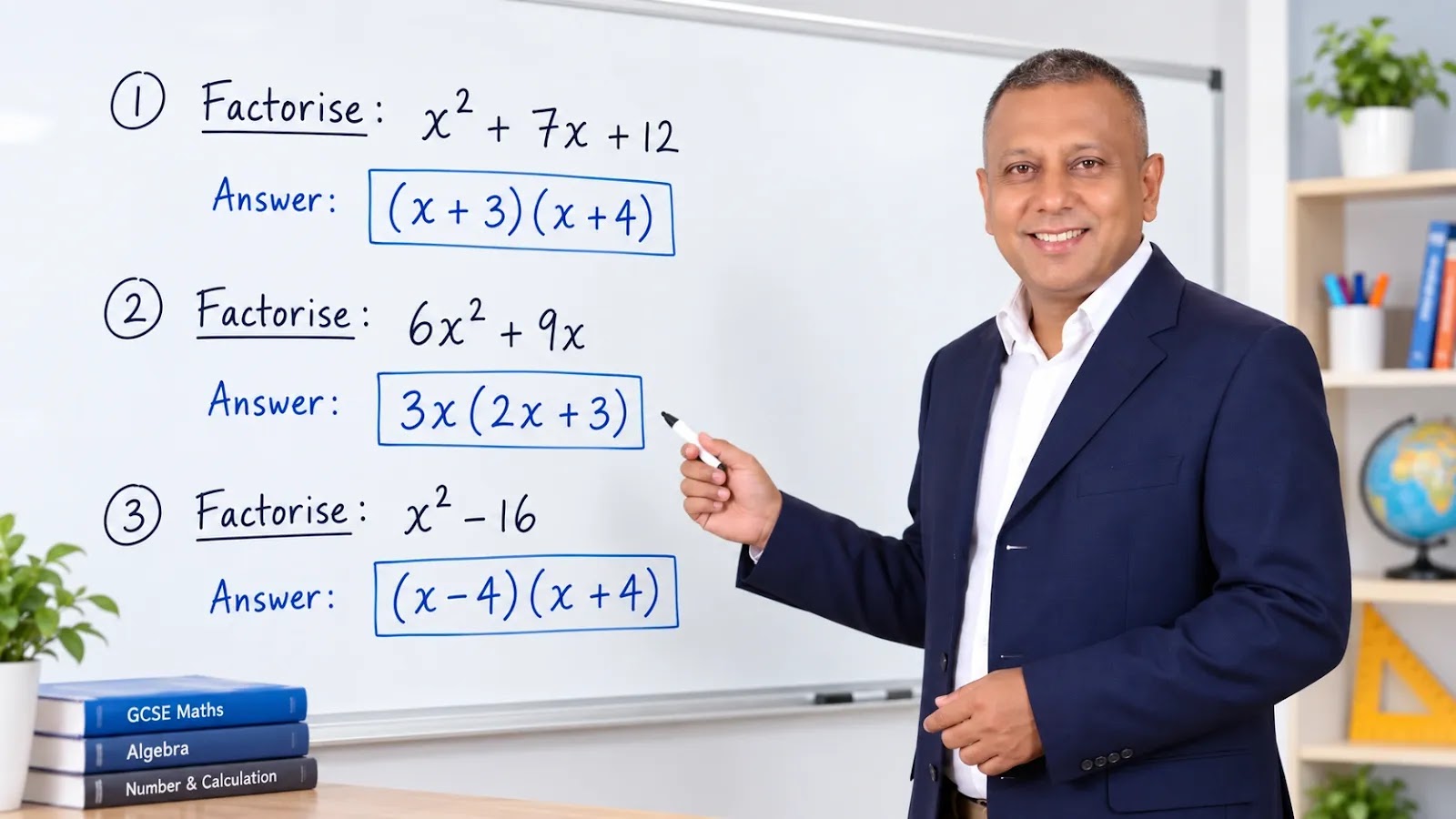
Why is GCSE Maths important?
GCSE Maths is important because it supports everyday numeracy, provides a foundation for many A-level subjects and can affect entry requirements for sixth form and university. It also develops reasoning and problem-solving skills that extend beyond mathematics itself.
The subject covers far more than arithmetic. The AQA GCSE Mathematics specification groups its content into six broad areas:
- number;
- algebra;
- ratio, proportion and rates of change;
- geometry and measures;
- probability; and
- statistics.
Students therefore move from fractions, percentages and standard form to equations, graphs, trigonometry, probability and statistical interpretation.
The challenge is not simply remembering this content. GCSE Maths questions frequently require students to decide which mathematics is needed before they can solve the problem.
What makes GCSE Maths difficult?
One reason students find GCSE Maths demanding is that topics are interconnected.
A student answering one problem may need to combine percentages, algebra, graphs and reasoning. The question may not tell them which method to use.
For example, a question comparing two mobile-phone contracts could require a student to:
- calculate a percentage increase;
- construct an algebraic expression;
- interpret a graph;
- compare total costs; and
- justify which option provides better value.
This is why memorising isolated procedures often produces disappointing results in unfamiliar exam questions.
Under AQA’s assessment objectives, a substantial proportion of marks is allocated to mathematical reasoning and problem-solving rather than straightforward recall. Students must recognise a suitable method, use it accurately and often communicate their reasoning clearly.
Where is GCSE Maths used in everyday life?
The phrase “you will use maths in real life” can sound vague. In practice, GCSE-level mathematics appears surprisingly often.
- Money: percentages, interest, discounts, taxes, bills and comparisons between monthly and total costs.
- Shopping: unit pricing, proportional reasoning and comparing offers.
- Travel: distance, speed, time, currency conversion and fuel use.
- News and information: interpreting percentages, averages, graphs and statistics.
- Home and practical work: area, volume, scale, measurement and estimation.
Understanding statistics is particularly useful. A graph can appear dramatic because of the scale chosen for its axes, while a headline percentage may mean very little without knowing the size of the sample or the original value.
Maths therefore contributes to the ability to question numbers rather than simply accept them.
Why does GCSE Maths matter for other subjects?
Mathematics is embedded in many subjects that students may study after GCSE.
In Physics and Chemistry, students rearrange equations, work with standard form, interpret graphs and convert units. Biology increasingly involves data and statistics. Geography uses scales and quantitative information. Economics, Psychology, Computer Science and Business also require varying levels of mathematical reasoning.
A student who is already fluent with GCSE algebra and arithmetic can concentrate on learning the new subject instead of struggling simultaneously with the underlying mathematics.
Why does your GCSE Maths grade matter at sixth form?
Your GCSE Maths grade can affect which courses you are allowed to study after Year 11. In particular, sixth forms frequently specify minimum grades for A-level Maths and Further Maths, and requirements vary between institutions.
| GCSE Maths result | Why it may matter |
|---|---|
| Below grade 4 | Students in England who have not achieved the required Level 2 standard generally have to continue studying maths as part of an eligible 16–19 programme. |
| Grade 4 or 5 | A grade 4 is regarded as a standard pass, but it may not meet the entry requirement for A-level Maths. |
| Grade 6 or 7 | These grades may meet the requirements for A-level Maths at many sixth forms, although individual institutions set their own thresholds. |
| Grade 8 or 9 | Higher GCSE grades are commonly expected for Further Maths at institutions with more demanding entry requirements. |
Students and parents should always check the current published entry requirements of the particular sixth forms or colleges being considered.
For the 2026–27 academic year, Department for Education guidance states that students in relevant 16–19 programmes who have not achieved grade 4 or above in GCSE Maths must continue appropriate maths study. Full-time students who achieved grade 3 are required to study towards GCSE Maths.
Read the current Department for Education guidance .
Does GCSE Maths matter for university?
Yes. Universities can use GCSE Maths as either a minimum entry requirement or part of an applicant’s wider academic record, although requirements differ substantially between courses and universities.
For some degree courses, GCSE Maths is simply a minimum requirement. For more quantitative programmes, universities may require a higher grade.
Applicants should therefore check the exact entry requirements for the courses they are considering rather than assuming that one GCSE Maths grade is sufficient everywhere.
The connection can also be indirect:
- Your GCSE Maths grade can affect which A levels you are allowed to take.
- Your A-level subjects influence which university degrees you are eligible to apply for.
- Some universities also look directly at GCSE results.
For a Year 10 student this may feel a long way away, but keeping options open is one reason GCSE Maths deserves consistent attention.

Can you improve GCSE Maths without a tutor?
Yes. Many students can improve significantly without a tutor if they identify their weaknesses, practise consistently, correct mistakes carefully and use good-quality revision resources. The important factor is not simply how many questions are completed, but whether the student learns from each mistake.
There is now an excellent range of free GCSE Maths material available online. In many cases, students already have access to everything they need.
The real challenge is using those resources systematically.
What are the best free GCSE Maths revision resources?
1. Corbettmaths
Corbettmaths offers short topic videos, practice questions, answers and its well-known 5-a-Day exercises.
The 5-a-Day format is particularly useful for maintaining skills across different topics instead of revising only one chapter at a time.
2. Maths Genie
Maths Genie provides GCSE Maths videos and exam questions organised by topic and approximate grade level.
This makes it especially useful when a student wants to progress gradually from easier questions to more demanding ones.
3. Dr Frost Maths
Dr Frost Maths provides extensive interactive mathematics practice and immediate feedback.
4. BBC Bitesize
BBC Bitesize offers clear written explanations and concise revision material.
It can be useful when a student wants a quick explanation of a concept rather than another long video.
5. Oak National Academy
Oak National Academy provides complete free lesson sequences and can be particularly helpful when a topic needs to be relearned from the beginning.
6. Exam-board past papers
Students should also use official past papers and mark schemes from their own examination board, such as AQA, Pearson Edexcel or OCR.
Physics & Maths Tutor also provides useful collections of revision material and past-paper questions.
How should you revise GCSE Maths effectively?
A simple structured routine is usually more effective than repeatedly watching videos or completing random worksheets.
1. Start with a diagnostic paper
Complete a past paper under reasonably realistic conditions and mark it carefully.
Do not record only the final score. Write down why each mark was lost.
For example:
- forgot the formula;
- did not recognise the topic;
- algebra error;
- calculator error;
- unit conversion error;
- did not understand what the question was asking;
- ran out of time.
2. Find the underlying weakness
A difficult topic is often caused by an earlier gap.
If algebraic fractions are difficult, the real problem may be ordinary fractions or factorisation. If trigonometry is difficult, the weakness may actually be rearranging equations or interpreting diagrams.
Go back one step before trying to move forward.
3. Use videos actively
Watching someone else solve mathematics can create the illusion of understanding.
A better method is:
- watch the explanation;
- pause before the worked example is completed;
- attempt it independently;
- compare your method;
- close the video; and
- attempt several new questions.
If you can only solve the question while watching the teacher, the skill has not yet become independent.
4. Practise a little and often
For many students, 20–30 focused minutes of Maths on several days each week is more useful than one very long session shortly before an assessment.
Mixing topics is important because the real examination does not tell you which chapter each question came from.
5. Keep an error log
An error log can be one of the most useful GCSE Maths revision tools.
Instead of writing:
“I got question 14 wrong.”
write:
“I recognised Pythagoras but squared 12 incorrectly.”
or:
“I did not recognise that this was an inverse proportion question.”
The second description tells you exactly what needs to improve.
6. Re-test yourself
Every two or three weeks, complete another paper or substantial mixed assessment.
Compare:
- your total score;
- which topics are improving;
- which mistakes continue to appear; and
- whether you are becoming faster and more accurate.
Example GCSE Maths weekly revision plan
- Monday: 20 minutes of mixed questions.
- Tuesday: revise one weak topic and complete practice questions.
- Wednesday: 20 minutes of mixed questions.
- Thursday: another weak topic or past-paper questions.
- Friday: short review of mistakes made during the week.
- Weekend: one longer mixed exercise or part of a past paper.
During the final months before the examination, full timed papers should gradually become a larger part of the programme.
How can parents help with GCSE Maths revision?
Parents do not necessarily need to teach the mathematics themselves.
Often the most useful help is to provide:
- a regular revision routine;
- a quiet place to work;
- encouragement to review mistakes;
- realistic targets;
- access to suitable resources; and
- support without making every test score feel like a judgement.
Rather than asking only, “What mark did you get?”, try asking:
“Which mistakes are you going to fix before the next paper?”
That changes attention from the score to the learning process.
When might a GCSE Maths tutor help?
Independent learning is often enough. However, extra help may become useful when:
- the same mistakes keep returning despite practice;
- the student understands examples but cannot solve unfamiliar questions;
- important foundation skills are missing;
- confidence has fallen and revision is being avoided;
- the target is a high grade and written reasoning needs refinement;
- there is limited time before examinations; or
- the student needs a structured plan and accountability.
In these situations, the main benefit of good tuition should not simply be having someone explain more questions.
The greater value is diagnosis: identifying precisely where the difficulty begins and designing practice around that weakness.
How iBLaurel approaches GCSE Maths tuition
At iBLaurel, GCSE Maths tuition starts by identifying the student’s current level, recurring errors and target grade.
The aim is to address the causes of lost marks rather than simply work through one worksheet after another.
Lessons can include:
- GCSE and IGCSE Maths;
- Higher and Foundation preparation;
- algebra and problem-solving;
- exam technique;
- timed past-paper practice;
- preparation for A-level Maths; and
- support for students aiming for grades 7–9.
Waseem has around 30 years of teaching and tutoring experience across Mathematics and Science. Tuition is available online and, subject to location and availability, in person in parts of London.
The longer-term objective is for students to become increasingly independent, using the same high-quality free resources described above alongside targeted teaching where it is useful.
Frequently asked questions about GCSE Maths
Is GCSE Maths important?
Yes. GCSE Maths can affect sixth-form options, is required for many university courses and develops numerical and problem-solving skills used across education, employment and everyday life.
What GCSE Maths grade is considered a pass?
In England, grade 4 is generally regarded as the standard GCSE pass. Individual sixth forms, colleges and universities can require higher grades for particular courses.
Can I improve GCSE Maths without a tutor?
Yes. Many students improve through consistent independent practice using past papers, Maths Genie, Corbettmaths, Dr Frost Maths, BBC Bitesize and other free resources. Progress is usually fastest when mistakes are recorded and corrected systematically.
How often should I revise GCSE Maths?
Regular short sessions are usually more effective than irregular cramming. Several focused sessions each week, combined with mixed questions and periodic timed papers, provide a strong starting routine.
When should I start using GCSE Maths past papers?
Past-paper questions can be used throughout the course, but full timed papers become increasingly important once most of the specification has been taught and examinations are approaching.
Do universities look at GCSE Maths?
Many do. Some courses specify a minimum GCSE Maths grade, while other universities consider GCSE results as part of an applicant’s overall academic record. Students should always check the current requirements for the individual degree course.
Do I need a tutor to get a grade 8 or 9 in GCSE Maths?
No. A tutor is not essential for achieving a high grade. Strong independent students can reach grades 8 or 9 through careful study and extensive problem-solving practice. Tuition can be useful when specific misconceptions, exam technique or higher-level reasoning are limiting progress.
Need more targeted GCSE Maths support?
If independent revision is not producing the expected progress, iBLaurel offers one-to-one GCSE and IGCSE Maths tuition online and in selected areas of London.
You can discuss the student’s current level, difficulties and target grade before deciding whether regular tuition would be useful.
Contact iBLaurel