IB Chemistry Tutor Germany – 30 Years’ Experience
One-to-one online IB Chemistry tuition for students across Germany, from Berlin and Frankfurt to Munich, Düsseldorf, Hamburg and beyond. I teach both SL and HL, combining clear concept teaching with calculation practice, current-paper exam technique, and ethical guidance for the IB Chemistry scientific investigation.
- Personalised SL & HL teaching
- Paper 1A, Paper 1B & Paper 2 preparation
- Stoichiometry, energetics, equilibrium & organic chemistry
- Scientific investigation / IA guidance
- Past-paper and data-based question practice
- German evening times, taught live from London
Every enquiry comes directly to Waseem. No tutoring marketplace, no rotating tutors and no long-term package required before you have discussed the student’s needs.
Stuck on the Chemistry scientific investigation? Browse 75 IB Chemistry IA ideas — free, each with suggested variables and extensions.

Approximately three decades of teaching and tutoring in Chemistry, Physics and Maths, with one-to-one support for international students including learners in Germany.
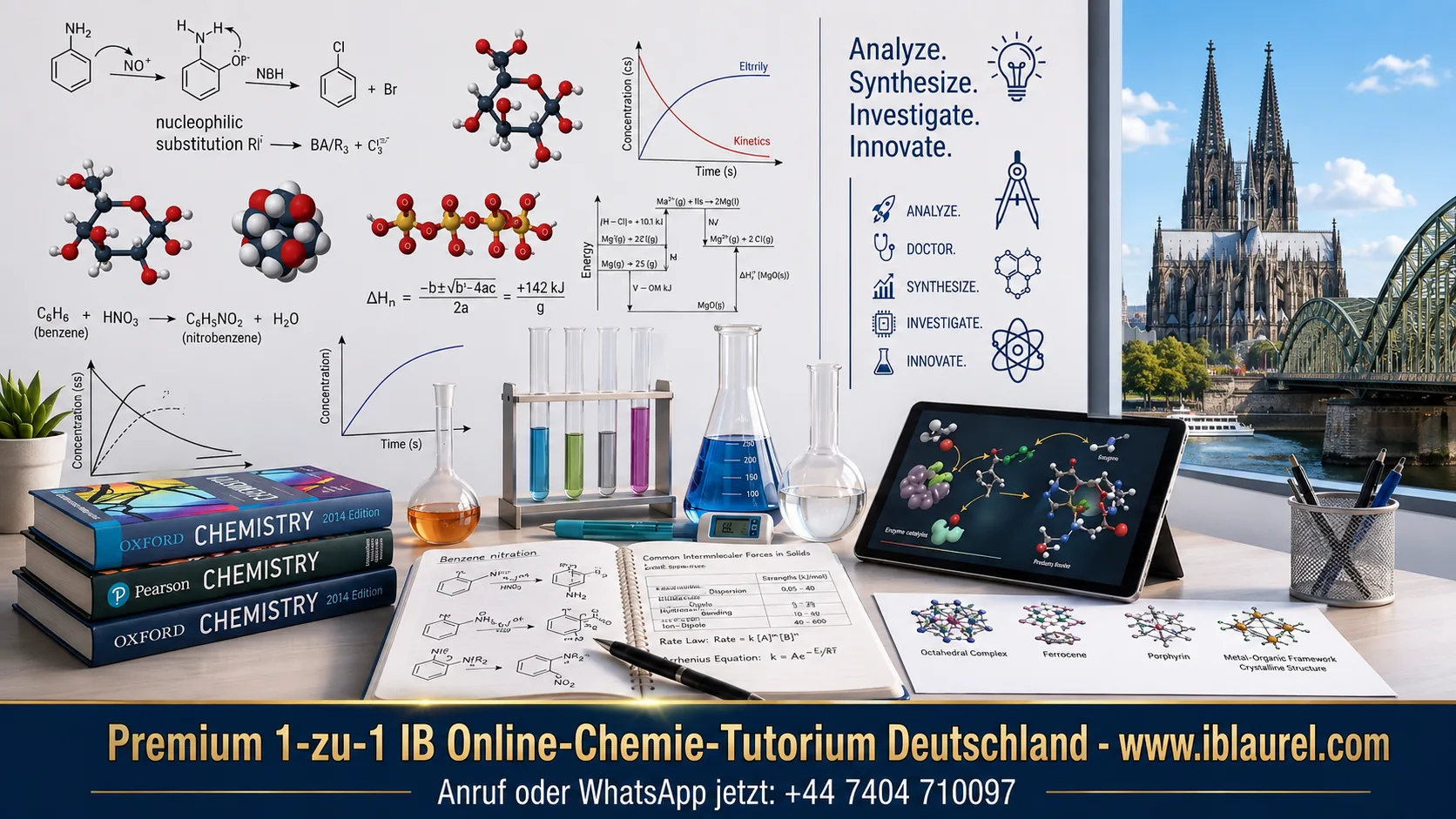
Premium one-to-one IB online Chemistry tuition · Germany-wide · WhatsApp +44 7404 710097
IB Chemistry is not a collection of facts. It is a connected problem-solving course.
The current IB Chemistry course is organised around structure and reactivity. Students have to move between particle-level models, quantitative calculations, experimental evidence and precise written explanation. That is why a student can know the notes and still find unfamiliar examination questions difficult.
Understand what matter is doing
Atomic structure, bonding, periodicity, molecular shape and intermolecular forces become much easier when they are taught as models that explain observable properties rather than as isolated definitions.
Connect calculations to chemical meaning
Moles, energetics, kinetics, equilibrium, acids and bases, redox and organic chemistry all demand the same habit: identify the governing principle, choose the correct relationship, and then interpret the answer chemically.
Think like an experimental scientist
Paper 1B and the scientific investigation reward data handling, uncertainty, method evaluation and scientific judgement. I help students build these skills while keeping assessed work entirely their own.
Common IB Chemistry difficulties — and what usually sits underneath them
Weak performance is rarely caused by one topic alone. The useful question is not simply “What chapter is difficult?” but “What kind of thinking is breaking down?”
Stoichiometry and mole calculations
Students often know the formulas but struggle to decide what the question is asking them to count. I teach a unit-aware route from chemical equation to amount, concentration, gas volume, limiting reagent and yield.
Energetics, equilibrium, acids and bases
These topics become hard when equations are memorised without meaning. We connect signs, units, graphs and equilibrium expressions to the physical chemistry so calculations remain reliable when the question is unfamiliar.
Organic chemistry and reaction pathways
Trying to memorise every reaction separately overloads memory. We organise reactions around functional groups, electron movement and recurring mechanisms, making synthesis and deduction questions more systematic.
Redox and electrochemistry
Oxidation states, half-equations, cell notation and electrolysis can feel like separate rules. I build them from electron transfer and charge balance so the procedures have one coherent logic.
Data analysis and practical questions
Students may carry out experiments successfully at school yet lose marks interpreting graphs, uncertainties, anomalous results or limitations. We practise the judgement the written papers and scientific investigation actually require.
Exam technique and time management
A correct idea can still miss a mark if the command term, definition, units, state symbols, significant figures or explanation are incomplete. We train mark-scoring precision without unnecessary writing, then add timed practice.
A lesson should solve the student’s problem, not simply cover the next page of a textbook.
My approach changes according to the student’s starting point, target grade and time available. The sequence below is simple, but it prevents tuition from becoming unfocused revision.
Diagnose
Use real questions to locate the gap: concept, calculation, interpretation, recall or examination technique.
Rebuild
Teach the underlying chemistry clearly, including any earlier idea the current topic depends on.
Apply
Move quickly into IB-style questions so the student learns to transfer understanding into unfamiliar contexts.
Refine
Review the answer against mark-scheme expectations, remove repeated errors and build speed without sacrificing accuracy.
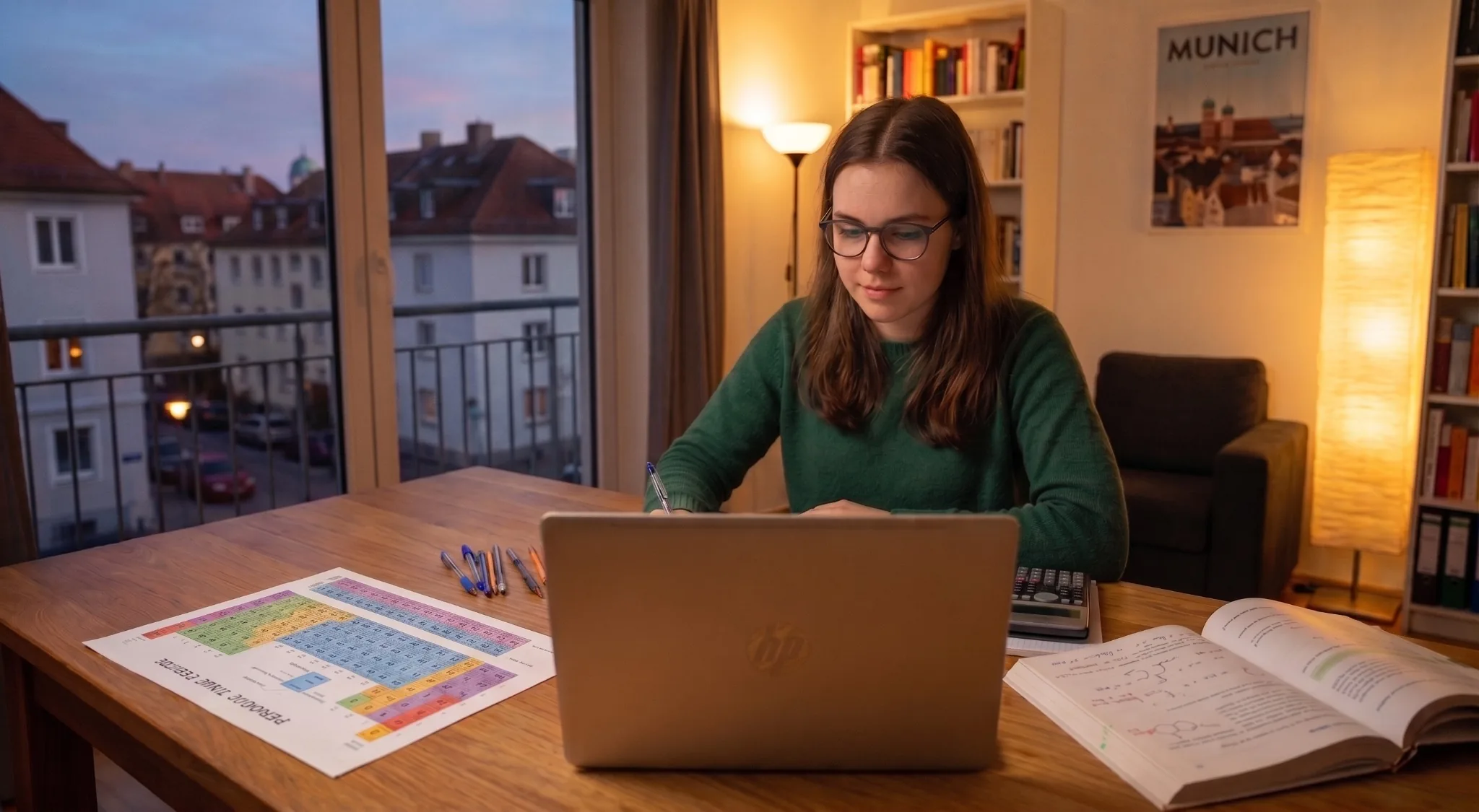
One student, one screen, one problem at a time
Lessons run from home, in the hours after school. The student brings the topic, the homework or the past paper that is causing trouble, and we work through it together on a shared digital whiteboard — writing equations, drawing mechanisms, plotting data and checking answers against mark-scheme wording as we go.
- Work follows the student’s own school course and materials.
- Mechanisms, calculations and graphs are built live, not just described.
- Notes from the whiteboard can be kept for revision.
- Parents receive a clear view of what was covered and what to practise next.
Online tuition that fits a German school evening
Germany is normally one hour ahead of the UK, so after-school lessons in Berlin, Frankfurt, Munich or Düsseldorf fit naturally into my teaching day. The screen is used as a working chemistry space: mechanisms, calculations, graphs and past-paper answers are built and corrected live.
A nationwide IB community — spread across several international-school regions
Germany’s IB community is not concentrated in one city. Families are distributed across major international centres, which makes subject-specific online tuition particularly practical. The examples below are included for geographic context, not as endorsements or affiliations.
Berlin
A substantial international-school community includes IB Diploma schools such as Berlin Brandenburg International School and several Berlin-based international schools.
Frankfurt / Rhine-Main
The Frankfurt area serves a large internationally mobile population, with IB provision including schools in Frankfurt, Oberursel, Bad Homburg and Dreieich.
Munich
Munich and its surrounding region include established IB communities such as Munich International School and Bavarian International School.
Düsseldorf / Cologne / Bonn
The Rhine-Ruhr corridor includes IB schools in Düsseldorf, Cologne, Bonn and the wider region, making it one of Germany’s most important international-school clusters.
Hamburg & beyond
Hamburg has long-established international education, while IB Diploma provision also appears in cities such as Bremen and Hannover.
Stuttgart / Heidelberg
Stuttgart and Heidelberg both have recognised international-school communities, with IB Diploma options serving students across Baden-Württemberg.
Independent service: iBLaurel is not affiliated with, endorsed by or partnered with the schools named above or with the International Baccalaureate Organization. School names are provided only to help families understand the geography of IB education in Germany. For current authorised-school information, use the IB’s official World School directory.
“He explained everything carefully and clearly… and pointed out the areas she needed to focus on to sharpen her exam technique.”Mamta · parent · IB HL Chemistry
Read more student and parent reviews →
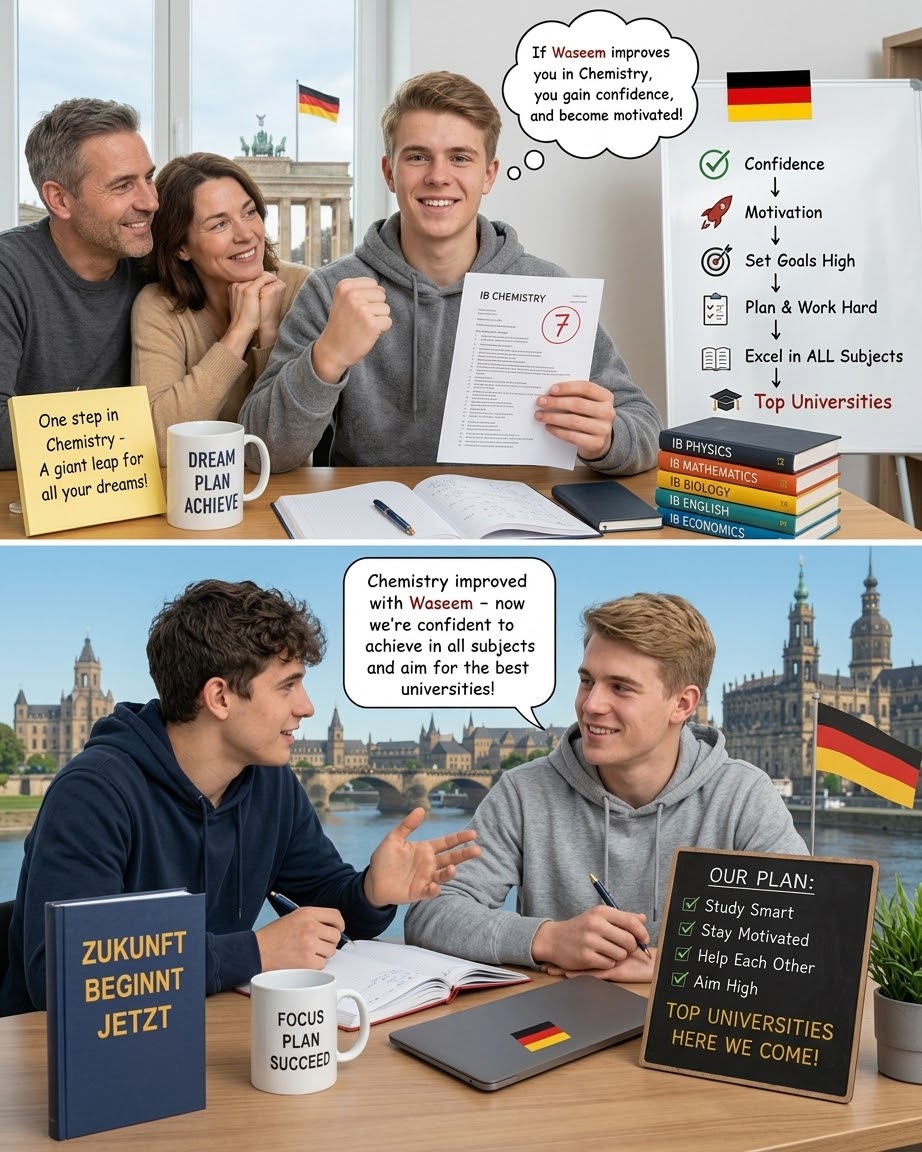
Thirty years of teaching experience, focused on the student in front of me
I have taught Chemistry, Physics and Maths for approximately three decades, including one-to-one work with international students in Germany and other countries. My role is not to replace the school course. It is to make the course work better for the individual student.
- The same tutor every lesson — Waseem personally teaches the programme.
- Lessons can follow current school topics, repair earlier gaps or become exam-focused as the year progresses.
- SL and HL are treated differently: HL receives the additional depth and quantitative demands it requires.
- Scientific-investigation guidance is developmental and ethical: planning, chemistry, data analysis and evaluation — never writing assessed work for the student.
- Parents can begin with a free consultation before deciding whether regular tuition is appropriate.
Explore the chemistry support before you book
These pages explain the teaching approach, the scientific investigation and the wider iBLaurel service in more detail.
Course structure, assessment, practical work and how tuition is organised.
Investigation75 Chemistry IA ideasInvestigation starters with variables, measurement approaches and extensions.
Your tutorAbout WaseemTeaching background, approach and international tutoring experience.
EvidenceStudent & parent reviewsFeedback from families who have used one-to-one tuition.
IB Chemistry tuition in Germany — FAQs
Do you offer IB Chemistry tuition to students in Germany?
Yes. Tuition for Germany is online and one-to-one. I work live from London with students across German cities and international-school regions, using Germany-friendly evening and weekend times.
Do you teach both IB Chemistry SL and HL?
Yes. Both levels share the broad structure of the current course, but HL requires additional depth and more demanding treatment in several areas. Lessons are planned around the student’s actual level rather than using the same material for everyone.
Can you teach students in Berlin, Frankfurt, Munich or Düsseldorf?
Yes. Because lessons are online, location within Germany is not a barrier. I also work with students in Hamburg, Cologne, Bonn, Stuttgart, Heidelberg and other regions.
Can you help with the IB Chemistry scientific investigation / IA?
Yes, within IB academic-integrity requirements. I can help a student refine a feasible research question, understand the chemistry, improve method design, analyse data and uncertainty, and evaluate limitations. I do not write or complete assessed work for the student.
What if the student is currently struggling with Chemistry?
That is often the best reason to start. The first priority is to establish whether the problem is a missing prerequisite, the current topic, calculations, interpretation or exam technique. Once the cause is clear, tuition becomes much more targeted.
Can you help a student aiming for a 6 or 7?
Yes. For students already performing reasonably well, lessons become less about re-teaching the syllabus and more about difficult mixed questions, precision, speed, data analysis and the small recurring errors that separate a good answer from a complete one. No specific grade can be guaranteed.
How does online Chemistry tuition work without a laboratory?
Practical experiments remain the school’s responsibility. Online tuition focuses on the chemistry around them: experimental design, calculations, uncertainty, graphs, interpreting data, identifying limitations and answering practical questions. Digital whiteboards are also particularly effective for mechanisms, equations and worked calculations.
How do we start?
Use the contact page or WhatsApp Waseem with the student’s level, current grade, exam session and the topics causing difficulty. We can then discuss whether regular tuition, a short diagnostic block or a focused exam session is the best fit.
Tell me where Chemistry is difficult. I’ll tell you how I would approach it.
A free consultation is enough to discuss the student’s school stage, SL or HL course, current performance, exam timing and the areas that need work. There is no obligation to book a package.